 By Sarah Whitlock
· 5 min read
By Sarah Whitlock
· 5 min read
I had morning neck pain for 4 years. The fix took one night.
I'd tried physio, a chiropractor, a $300 "cervical contour" pillow, and the rolled-towel-under-the-neck trick from Reddit. Then my sister sent me a $99 grid pillow she'd found online. By morning one, my neck felt different. Three weeks in, I'm pain-free for the first time since 2022.
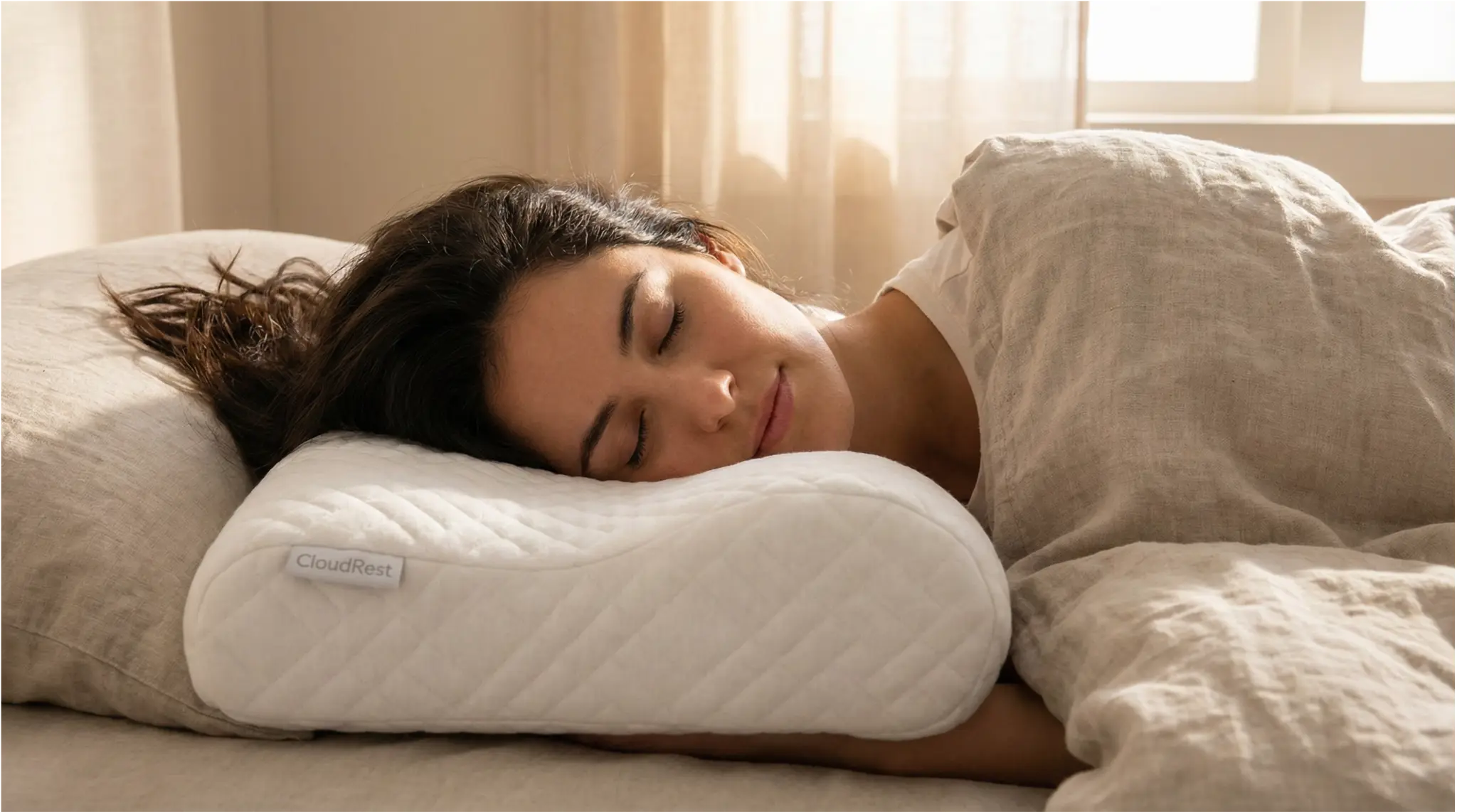


If three or more of these are true, your pillow is the problem.
Most chronic morning neck pain isn't a posture issue, a stress issue, or a "you're getting older" issue. It's the eight hours your neck spends unsupported every night.
Everything I tried that didn't work.
Before I figured out it was the pillow, I spent two years and a small fortune on things that promised to fix it. None of them did.
I spent $1,809 trying to fix this. Nothing worked.
Physiotherapy
Helpful for an hour. The pain came back the next morning because I went home and slept on the same pillow.
Chiropractor
Felt great when I left. The relief never lasted past the first night's sleep. I stopped going after six visits.
"Cervical contour" pillow
The dense memory foam ran hot, didn't actually contour to my neck, and gave me a headache by week two.
Standing desk + ergonomic chair
Probably good for me. Did nothing for the morning stiffness. The pain was sleep-shaped, not desk-shaped.
"McKenzie" neck stretches
I did them religiously every morning for six weeks. Marginal improvement that disappeared the moment I stopped.
Magnesium + sleep tea
I slept slightly better. I still woke up unable to turn my head to the left for ten minutes.

Then a friend asked the obvious question:
"How old is your pillow?"
I genuinely couldn't remember. It was at least four years old. It had no support left. I'd been sleeping with my head tilted off-axis for half a decade.
Why a wrong pillow destroys your neck.
Your cervical spine is supposed to keep its natural C-curve all night. A flat or collapsing pillow lets your head drop, which stretches the small muscles at the base of your skull for 6–8 hours straight.


Ergonomic contour holds your C-curve
The dip in the middle cradles your skull. The raised edges fill the gap between your neck and shoulder when you're on your side. Your spine stays in a single line all night.

Adaptive grid won't collapse
Foam compresses and stays compressed. Down clumps. The TPE honeycomb springs back the moment you shift — so the support doesn't disappear at 3 a.m.

Pressure-relieved across the whole pillow
Each cell flexes locally where you press. There are no hard "edges" to dig into your trapezius and no soft sinkholes for your head to collapse into.
Built for back and side sleepers
Most cervical pillows pick one position. Onyx adapts: the same pillow supports your neck on your back and fills the gap between your neck and shoulder on your side.
Not a side sleeper? It's still your pillow.
The dull morning headache you've been calling "a bad night".
Back sleeping looks like the safe position — until you realize a flat pillow lets your head tilt back 15–20° below your spine line, loading the small muscles at the base of your skull for 7–8 hours straight. That's where the dull morning headache most back sleepers write off as "a bad night" actually comes from. The Onyx contour cradles the back of your skull so your neck stays at neutral, not stretched.
Not stress. Compression.
Most chronic tension headaches that wrap from the base of your skull around to your temples aren't a stress problem — they're a compression problem. For 6–8 hours a night, the roughly 11 lb (5 kg) of your skull rests on the small muscles at the back of your neck. A pillow that doesn't relieve that spot is doing the damage paracetamol is cleaning up the next morning. The Onyx grid distributes the load across the whole pillow surface instead of concentrating it at the pressure point.
The position most pillows can't handle.
Side sleeping is the worst-case scenario for neck alignment — you need a pillow tall enough to fill the gap to your shoulder, but soft enough to not jam into your jaw. Watch what the grid does:
The grid fills the gap between your neck and shoulder — and stays filled all night.
On a flat pillow, your head drops about 1.2 in (30 mm) below your spine line every time you roll onto your side. Multiply that by 3–5 hours of side-sleeping per night and you've got a recipe for the morning stiffness most side-sleepers think is "just normal."
The Onyx contour is taller along the long edges (where your shoulder is) and softer in the center (where your face goes). One pillow, both positions.
Try Onyx risk-free — $99 →What actually works for chronic neck pain.
We compared the Onyx against three of the most-recommended pillow types for neck pain sufferers in America.
 Onyx
Onyx
|
 Memory foam contour
|
 Latex
Latex
|
 Down / feather
|
|
|---|---|---|---|---|
| Holds neck alignment all night | ✓ | ~ | ~ | ✗ |
| Adapts to back AND side sleeping | ✓ | ✗ | ~ | ~ |
| Doesn't compress over months | ✓ | ~ | ✓ | ✗ |
| Stays cool — no flipping | ✓ | ✗ | ~ | ~ |
| Hypoallergenic + machine-washable cover | ✓ | ✗ | ~ | ✗ |
| 100-night risk-free trial | ✓ | ✗ | ✗ | ✗ |
| Price (USD) | $99 | $200–400 | $180–350 | $140–400 |
3,547 customers switched. Many came for the neck pain.

"First morning without neck pain in two years."
I'd been on a memory foam contour pillow that I thought was the solution. Turns out it was the problem. Onyx held me up properly even on my side. Eight days in and the headaches stopped completely.

"The morning headaches are gone."
I've had base-of-skull tension headaches on and off for years. I'd given up on fixing them. Two weeks on the Onyx and they've simply stopped. I almost don't trust it.

"I can turn my head when I wake up."
For two years I'd start the day unable to turn my head left without a sharp click. After a month on this pillow I genuinely don't think about my neck anymore — which I haven't been able to say in a long time.

Try it for 100 nights. Send it back if your neck doesn't change.
If three weeks of Onyx doesn't fix what physio and a $300 contour pillow couldn't, we cover the return shipping and refund every cent.

Standard size · 24 × 16 × 4.7 in (60 × 40 × 12 cm) · Fits a standard US pillowcase
The Onyx AeroMatrix Pillow
Standard size · Removable cover · 100-night trial
50% off ends Sunday — over 1,200 pillows shipped this week
Neck-pain questions, answered.
How long until I notice a difference in my neck pain?
Will it work if I sleep on my side?
I've tried "cervical contour" pillows and hated them. How is this different?
Is it OK if I have a herniated disc / cervical issue?
What if I move around a lot in my sleep?
What's the size? Will it fit my pillowcase?
What if it doesn't fix my neck pain?
Sarah Whitlock is a US-based health and sleep writer. After four years of morning neck pain, she now writes about what actually works — and what doesn't.
★★★★★ Verified Onyx owner since 2025Stop waking up stiff.
$99. 100 nights to prove it works. Free returns if it doesn't.
Try Onyx risk-free — $99 →